Song: “The Perfect Drug” by Nine Inch Nails Year Release: 1997 – Year “Discovered” By Me: 1997 Reason Discovered: Music video on MTV
Why a fan? In 1997, I was your average, slightly nerdy, suburban teen. I had a passing interest in music, but my CD collection at the time didn’t go much further than The Presidents of the USA, No Doubt, Weird Al, and the Batman Forever soundtrack. Growing up, there was always music around or in the car, but it wasn’t a defining characteristic in my life.
That all changed after I saw the video for Nine Inch Nails’ “The Perfect Drug” (insert snarky video-on-MTV comment here). Mark Romanek, director of the infamous video for “Closer,” spent $1 million on the gothic, blue-tinted homage to Edward Gorey. In it, Trent Reznor confronts the death of a child and falls into an absinthe-fueled abyss.
The video, like the song, is menacing, bold, and aggressive. All things that spoke to my barely-teenaged self. In the pre-mp3 age, I spent hours analyzing the song in a Midi file, breaking down the various tracks: the simple, repetitive guitar riff, the battling synth lines, and the staticky, drum-and-bass backbeat. Reznor’s lyrics are classic Nine Inch Nails: questioning self-worth, twisted desire, and loss of control.
I was hooked, and soon picked up the Lost Highway soundtrack and Pretty Hate Machine. Other alternative rock staples would follow. Returning to school in the fall of ’97, I was newly outfitted in band tees, JNCO jeans, and Airwalks (I tended more towards standard 90s skater gear than goth. No makeup or fishnets for me!). “The Perfect Drug” is the song that opened my eyes, not just to particular genres of music, but to a worldview and music-infused lifestyle that are still very much part of me, over a decade later.
Ironically, “The Perfect Drug” is Reznor’s least favorite creation, due to the hurried production and overwrought video. Nine Inch Nails never played the track live. Still, the song is centrally important to who I am today, because it started my musical addiction.
Part of the True Genius Requires Insanity Crate Dig series.
Pariahs are despised, rejected outcasts. Hopefully, fledgling UK beatmaker Pariah will not suffer the same fate.
Arthur Cayzer is a 21-year old London university student who has only been producing for a year, but his talent belie his age and experience (despite his limited output). Signed to veteran Belgium dance music label R & S Records, Pariah is already making a name for himself with music that borrows from dubstep, UK funky, house, and future hop.
His first release, “Detroit Falls,” transforms a classic soul sample into a churning glitch fest. The track’s construction is reminiscent of an artist from its titular city: the late, great J Dilla. Bits and pieces of the original sample are interspersed with low end and synth chirps, creating a cohesive sound that satisfies both dubstep devotees and hip hop heads.
“Orpheus,” the b-side to “Detroit Falls,” keeps the tempo consistent but moves towards funky and house as Pariah re-works Thelma Houston’s disco classic “Don’t leave me this way.” It’s an “a-ha” moment; while other dance remixes of the track have focused on the upbeat chorus, Pariah opts for the yearning vocals of the verse. It’s a perfect fit for the syncopated, tribal beat.
Pariah also tried his hand at remixing, starting with his fellow countrymen, Ellie Goulding and the XX. His remixes of “Under the Sheets” and “Basic Space” present UK funky takes on songs that have already been remixed ad nauseum. For an extended look at his DJ skills and range, check out the bass-heavy mix he did for Sonic Router. The mix includes tracks by vets like Martyn and L-vis 1990, along with a hint at what’s to come from Pariah.
With such an abundance of promising young UK producers, it is difficult to separate the wheat from the chaff. But if Pariah continues to release tracks like “Detroit Falls” and “Orpheus,” it will be that much easier. And remember, don’t fear the wobble.
Welcome to The Verge: a column dedicated to music on the edge of a breakthrough. Last time, I profiled two rising female-fronted indie rock bands, the Dum Dum Girls and Screaming Females. Now, it’s time to replace those guitars with synths.
A lookbook is used by fashionistas to showcase a particular designer or style. Minneapolis band Lookbook is a duo that showcase a particular style of electronic music that is equal parts dream pop and synth pop.
Grant Cutler (synths) and Maggie Morrison (vocals) fit the mold of similar outfits like La Roux, Beach House, and the Knife, combining a chanteuse with a male partner behind the boards. Like those groups, their sound owes much to 1980s electro pop of all stripes, with sweeping synth strings, metallic drum machine beats, and effect-laden vocals.
Lookbook’s first EP, I Fear You, My Darkness, was self-released in late 2008. As the title suggests, the band covers dark sonic and lyrical territory. The EPs five songs find the pair brooding over atmospheric soundscapes; it’s more new age than new wave. The highlight is definitely the seven minute “Steal the Night,” an epic that evokes the emotional tone of Patti Smith’s similarly-titled “Because of the Night.”
In 2009, Lookbook released their full-length record Wild At Heart. While I Fear You, My Darkness feels cathartic, Wild At Heart allows the band to expand and enrich their sound. The songs are more upbeat and danceable, but darkness and vulnerability remain just below the surface. Morrison’s vocals are sharper and less dreamy, somewhere between Karen O and Cyndi Lauper. The album opens with “Over and Over,” which builds for nearly the entire length of the song to a pounding, crashing climax.
Throughout Wild at Heart, Cutler’s beats command you to dance to songs full of shimmering keys and electronic chirps. Morrison is charismatic on the mic, with stylized, flowing verses and full-throated choruses. And for a style that is not necessarily novel, I think the duo captures and modernizes 80s synth pop better than some of their contemporaries; Wild at Heart compares favorably to It’s Blitz!, the Yeah Yeah Yeah’s foray into similar ground.
If 1980s revival is the fashion, Lookbook is the guide to the style.
Salem makes scary music. Music that exists somewhere between chopped-and-screwed, industrial, and dubstep – a dreary, grating, drugged out amalgamation that is challenging and unforgiving. And I can’t stop listening to it.
This week, Salem released a mixtape for DIS magazine, an art outfit that fits the Salem worldview. The mix, entitled Raver Stay Wif Me, is 32 minutes of both familiar and obscure tracks, twisted and manipulated to the edge of recognition. The titular raver is paid tribute by classic tracks like “Better Off Alone” by Alice Deejay, “Sandstorm” by Darude, and “Can’t Stop Raving” by Dune, trance tracks whose hypnotic affect is still apparent, even if the music is better suited for cough syrup sipping than Ecstasy popping.
It may be an act, but only Salem is twisted enough to include a track by a convicted sexual predator: South Park Mexican‘s “Vogues” is a record-skipping center piece of the tape. Too sick for you? They include “Unchained Melody” and “Young Forever,” classic love songs that just seem wrong in contrast to the rest of the mix.
Not much is known about the Michigan trio of John Holland, Heather Marlatt, and Jack Donoghue; they don’t give many interviews, or take photographs, or humor the social media crowd. Instead, they keep a public image that mirrors their music: dark, mysterious, unnerving. Their music videos don’t give many clues, either, except that the band may need psychological help. Check out the NSFW clip for “Skullcrush,” a video that makes M.I.A.’s “Born Free” look like a Disney film.
Raver Stay Wif Me is another required listen from a group whose limited press EPs Water and Yes I Smoke Crack are equally challenging and rewarding. And if all this is too dark for you, check out their remixes of Gucci Mane, a match made in Hell.
Fugative, aka Harry James Byart, is a pop rapper from Essex. Just sixteen years old (and exactly ten days younger than Mr. Bieber), he writes and produces his music with Richard “YoungLord” Frierson. The pairing is a natural fit, as the Top 40 hip-hop producer was also a sixteen year old prodigy, working with Puff Daddy’s Hitmen Production Team in the mid-90s. The Bad Boy connection goes deeper, as Fugative is signed by Bad Boy co-founder / ex-Mary J. Blige manager Kirk Burrowes.
Fugative’s hip-hop is the sonic and lyrical counterpoint to Bieber’s R&B: age-appropriate, de-sexualized, “schools and girls are confusing” territory. The beats range from 90s dance throwbacks (“It’s Summertime,” which reached #4 on the UK R&B charts) to re-hashed club beats (“Supafly” apes the fills from “Drop it like it’s hot”). Still – a hit is a hit, and Fugative’s audience probably doesn’t care about originality.
Between shuttling him between Atlanta and the UK and building his social media presence, the team behind Fugative are also trying something novel to boost their young performer. Remixes of his tracks are not coming from Timbaland or Young Money – but from top EDM producers like A1 Bassline, Roska, and Moto Blanco.
In fact, I first found Fugative while searching for a song with an infectious “I think I’ve got a crush” hook. Turns out the song was Fugative’s “Crush” (single release on May 10th), remixed by none other than TGRI-favorites Nadastrom. Keeping the pop melody and sugary hook, the guys dropped most of Fugative’s rapping in lieu of some serious wobble:
By brandishing his blog credentials before he even gets a stateside release, Fugative will already be on the minds of taste makers and culture fiends when he gets a US push. Probably just in time for the summertime.
After exploring drum-and-bass producers who have taken the dubstep plunge, I was not surprised that another up-and-coming bass producer was among their ranks. This week’s Dubstep Dossier is dedicated to a producer you need to know: Redlight.
Redlight, the DnB DJ formerly known as Clipz, first appeared on my radar when Rusko dropped his track “My Love” (among others) in his Mishka Mix. Between the catchy house vocal, funky rhythm, and big drops of “My Love,” Redlight looked like someone to keep an eye on. (PS If you still haven’t copped that Rusko mix, it’s essential listening. I’ll wait for you to go download it.)
The Bristol-based producer released the Lobster Boy EP last fall, and the four track EP builds on the promise of “My Love,” bringing together elements of dubstep, funky, breaks and grime, with a Caribbean feel that speaks to dubstep’s origins. If you’re a fan of Major Lazer’s dance floor alchemy, Redlight’s material will be just as infectious.
The tracks are dance floor killers. “Pick Up The Phone,” featuring Jenna G & Jammer, even adds a touch of club to the mix, while “Kid Soldier” is all wobble, Redlight turning knobs like a NASA controller. The reggae-rave of “Feel So Good,” commands the crowd to “wine up ya body… move to the riddim.” Check the video:
The highlight of the EP is “Be With You,” which will have audiences alternating between daggering and old school raving. The beat is a consistent engine as the song shifts between toastmaking and vamping.
Redlight’s newest single, “Stupid,” features singer Roses Gabor and pushes further into UK funky, while maintaining enough low-end for true bassheads. The video is a psychadelic, tribal dance-off. To quote Liz Lemon, “I want to go to there.”
Between his output and hosting his own “In New 1Xtra DJs” program on BBC Radio, Redlight names EDM heavy-hitters Skream, Toddla T, Jack Beats, Goldie, Carl Cox, Pete Tong and Annie Mac among his fans. Not bad company to join. And remember, don’t fear the wobble.
Meet Menya – a brash, electroclash-meets-party rap group out of New York. Out of NYU’s Tisch School of the Arts, to be specific: the twentysomething trio of Good Goose, Coco Dame, and Angie Ripe (names changed to protect the not-so-innocent) are getting their musical education both in the classroom and in the club.
Angie Ripe and Coco Dame are Menya’s sugar and spice, with Angie’s sultry singing and Coco’s fearless rapping over beats and keys by Goose. The no-frills set-up allows the band to oscillate between grimey, sex-fueled bangers (“Ripe” and “D.T.F.”) and summery, synth-poppers (“Bushwick Baby” and “Sleepover”). They do each equally well, which makes the Menya experience fun and playful – but decidedly naughty.<
Check out this TGRIOnline exclusive remix of “Loose” by STAMPED DJ James Nasty. He gives a Bmore feel to a song that demands the listener “twist my arms / bend my legs / pull my hair / I like it that ooh I like it that.” James Nasty and Menya – a perfect fit.
And while the band covers Top 40 pop songs by Justin Bieber and 3Oh!3, they have a knack for flipping the lyrical message into something a little more Menya-like: Kelly Clarkson’s “I Do Not Hookup” becomes “(So what) I hook up,” for example:
I’ve seen Menya rock a capacity-crowd show at NYC’s Bowery Poetry Club and a cramped basement show at the 3rd Street Co-op here in DC; both were shows for the ages that left the crowd sweaty, breathless, and ready to party. Menya is returning to the DMV the weekend, playing two shows that promise more of the same. On Friday, Menya will be at the University of Maryland for The Get Down, with Bullfight Academy and Leftist. On Saturday, the band headlines the Faze Electro Dance Party at Jammin Java with DJs Ypset and Santi.
I had a chance to speak with Goose and Coco about the past, present, and future of Menya.
Where’d you guys grow up, and how long have you been performing as a group?
Goose: I grew up in northern Virginia and got out as soon as I could. As a group, we’ve been performing together about two years. Our first show was April of 2008. We were quite a sight then. I was dressed in really casual clothes- a hoodie and jeans. Angie and Coco were dressed almost entirely in sparkles and gold lame. There are pictures somewhere. Coco: I was born in Manila, Philippines and grew up in Maryland, near DC.
What musical influences have resulted in the sound of Menya?
Goose: I’m obsessed with the production on late 90s and early 2000s hip-hop: Timbaland and the Neptunes, mainly. I’d like to think my contributions are a combination of that and my lifelong love of Stephen Merritt’s projects. Coco: Spank Rock, M.I.A., The Cure, Lil Kim, T. Rex, Prince, KRS-One. Artists who are lyrically clever or thoughtful, and are not afraid to expose themselves and put themselves on the line to speak their mind.
Your re-fix/re-mixes have put a fun twist on hit songs. How’d you come up with that approach to covering songs?
Goose: We’re big youtube fans. We were seeing a lot of DIY parody-type videos and wanted to give it a shot with our own brand of silly potty humor. Plus it allows us to cover our favorite guilty pleasure pop songs. I love Justin Bieber’s music a lot, actually. How lame am I? Coco: I barely listen to the top 40, mostly because I only really listen to the radio waiting in line in a store, or when I am in the car with the band. Covering popular songs, even ones I didn’t necessarily like at the beginning, has kept me interested in the mainstream for a new reason- to pull a song apart and create something fun!
You guys recently did a spring break tour which I believe is your most extensive touring yet. How did that go?
Goose: I loved the tour. I ate so many burgers and we got to have biscuits at a Cracker Barrel in South Carolina. Best moment that wasn’t music related was swimming in Miami. Worst moment was the rain. There was so much rain on that tour. Coco: Worst moment by far was getting a stomach virus. Luckily it struck the only day we did not have a show. My friend’s mom was a sweetheart and helped me get better. I was upset because I couldn’t join the St. Patty’s festivities. Florida was my favorite state overall, and Charlotte has really wonderful drag queens! Met a lot of great people.
After seeing this video, I had to ask – how was meeting and playing with Andrew WK?
Goose: I’ve been a big AWK fan since I was in middle school when “Party Hard” came out. I gushed a little to him about how much I love his music at the show, which made me feel silly. Coco: I really appreciate him opening up his venue Santo’s Party House for us to throw a big show. The rumor that he is awesome is true- W.K. is a nice dude.
Any hints to what’s next for Menya?
Goose: We’re writing new songs in May, then touring for most of the summer and fall, mostly to places we’ve never been before like the midwest and hopefully up to Canada. The plan is to do about 50 dates before mid-August, which I’m booking now. After that, we plan on making our own organic fruit smoothies and outselling Lady Gaga. Coco: I will probably grow my hair out from my mohawk until I can’t stand it no more.
That would be Freddie Gibbs, on the phone from California, right before doing an interview with TGRIOnline on – of all days – 4/20.
As we’ve written before, true fans of hip-hop need to get familiar with Gibbs, an MC whose talent far exceeds his growing buzz. Gibbs is an unapologetic gangsta rapper, a throwback to an era that seemed to end with the back-to-back deaths of Biggie and 2pac. Repping Gary, Indiana, Gibbs weaves together real life tales about one of America’s toughest cities with a slick cadence that is always on-point, whether with a Pac-like staccato or Bone Thugs-influenced rapid fire.
Gibbs has already had a career-making 2010, being named to XXL’s Freshman Class and burning up SXSW. And his star continues to rise: his next mixtape, Str8 Killa No Filla, is slated for a late May, early June release, and an EP with The Alchemist (The Devil’s Palace) will follow. For an artist dropped by a label – and not looking to make another deal – XXL and SXSW are essential parts of making his own way in the game. “It’s vital. Without that, without blog exposure, I wouldn’t exist,” he confides.
Getting asked to play SXSW was a “blessing,” one that Gibbs didn’t take lightly: he played three shows a day and even did two studio sessions (one with DJ Burn One, and an exclusive for Ruby Hornet). His grind paid off: Entertainment Weekly put him in their “5 bands you should know” – the only rapper in their list. Gibbs enjoyed his first time at the Austin festival: “It felt like Woodstock or some shit… There were shows everywhere. It was trill.”
Now based in California, Gibbs insists it won’t affect his writing. “I’m Gary all day. Born and raised in Gary. Ain’t nothing bout my music will change.” He attributes this to a universal sound that defies regional pigeonholing: “Most people can’t put their finger on it.” While a lot of peers only listened to Midwest rappers, Gibbs became more well-rounded by listening to everything, guys like Rakim and Scarface.
The strength of Gibbs’ mixtapes is that they sound like fully-formed albums. “I do that shit on purpose. I sequence in a manner that tells a story, so you can let that shit ride.”Str8 Killa looks to be another one you can just let ride. “Crushin’ Feelin’s,” produced by Statik Selektah, is a piano and guitar driven slab of Southern-fried g-funk, where Gibbs coolly and confidently dismisses the rest of the game: “Rap ain’t nothing but talking shit, I’m just the best at it.” “Ghetto,” over the beat from Milkbone’s classic “Keep It Real,” Gibbs gets political: “Government funds fill my city up with guns and drugs.”
Rather than the self-described “bullshit” that most rappers put on mixtapes, Gibbs would “rather give a cohesive piece of music that tells a story.” For a reason: “Not enough people know me. I still have to tell them who Gibbs is. Whether it’s about robbing and jacking, or pussy, I incorporate the story in the rhymes, like you could put it to a movie.”
On 4/20, the subject of weed was bound to come up. A few live performances have been scuttled when the MC reached for a blunt on stage. “I’m used to smoking on stage, in hole-in-the-wall clubs. All these grimey-ass clubs in Gary… everybody be in that motherfucker smoking.” Smoking on stage is “taking it back to the crib,” so while some cities will pull him off stage, it doesn’t sound like he’s gonna stop. He even dropped a new track at 4:20 on 4/20 for weedsmokers, “Personal OG,” that he was putting the final touches on when we spoke.
In 2010, Gibbs will keep grinding. “I’m not dead or in jail for a reason,” he says. “As long as I keep my integrity and represent my area, the checks will come.” Apart from the mixtape and the EP, he’s also working on a project with Bun B, Chuck English, and Chip the Rippa. “I’m willing to work with anyone who has hard shit that I respect.” Gibbs will also continue collaborating with fellow XXL Freshmen Pill and Jay Rock. He has some shows in the works for this summer, and will be at the Pitchfork Music Festival in Chicago. But this is just the beginning of a journey for Gibbs. “I’d rather have a twenty year career than a two year career in this shit.”
Dubstep and drum-and-bass are kissing cousins, so it’s no surprise to see DnB producers slow down their breakbeats and get in on the subsonic fun. Both lend themselves to massive, enveloping tracks where bass, drums, and synths build and crash like the soundtrack for the Apocalypse, just at different tempos.
Mt Eden, a producer out of New Zealand, has successfully made the transition from DnB to dubstep by remixing and reworking a wide range of tracks. The key for Mt Eden (real name Jesse Cooper) is finding songs with a solid sense of atmosphere and melodrama, qualities that are accentuated by the addition of some wobble: Bat for Lashes’ “Daniel” and Imogen Heap’s “Let Go,” for example.
His track “Sierra Leone” relies on a sample from Freshlyground’s “I’d Like,” adding the original’s trademark ohhs and ahhs to an oscillating bassline and a jumpy backbeat:
Back in the UK, DJ Fresh (of DnB collective Bad Company) also seems to be moving in a dubstep direction. “Fight,” off his upcoming record Kryptonite, features cinematic strings and somber female vox until the chirps and squeals of a tortured synth enter the picture:
Dubstep pioneer Skream‘s nods to DnB are more apparent. His remix of La Roux’s “In for the Kill” (already a dubstep classic) descended into ravey madness with a huge breakbeat. His remix of Zomby’s “Float” is an even more overt DnB revival. The track (with its hilariously cumbersome title “Skream’s I was in infants school where were you in 92 mix”) is monumental: when the bass drops, you just may float off the dance floor:
With the emergence of dubstep and the re-emergence of drum-and-bass, songs that borrow from both genres are sure to be a staple for bass fanatics everywhere. And remember, don’t fear the wobble.
Bonus! Crossover Alert: Caspa – dubstep legend and frequent Rusko collaborator – lends his remix skills to Ludacris’ dance floor sensation “How Low” with fantastic results. Caspa replaces the original’s electro accents with a more bass-heavy feel, and gives the chorus a grinding beat that sounds just like the club-tech of Nadastrom’s remix of “A Milli.” Apparently, you can get even lower with dubstep.
Welcome to The Verge: a column dedicated to music on the edge of a breakthrough. After a look at the beginnings of another British Invasion, it’s time to return stateside for some female-fronted indie rock.
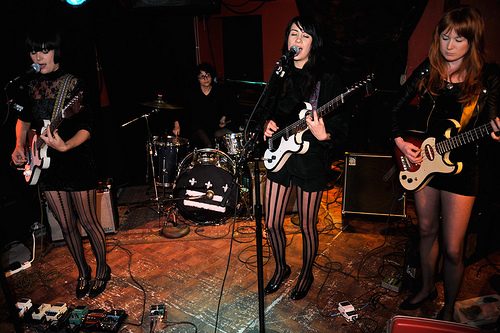
Seemingly appearing out of nowhere, the Dum Dum Girls signed to indie stalwart Sub Pop last year on the strength of a couple lo-fi EPs and literally one live performance. What started as a solo project by Kristin Gundred (aka Dee Dee) grew into an all-girl rock band that harks back to 60s girl groups, both in sound and style. Gundred had previously found success as a singer/drummer with garage rockers Grand Ole Party.
The Dum Dum Girls play jangly, fuzzed-out indie pop that makes audiences want to do The Monkey and The Swim. Their wall-of-sound is as much Phil Spector as it is Black Tambourine, the short-lived yet influential DC band that played in similar sonic territory in the early 90s. The lead single off of their debut LP I Will Be, “Jail La La,” is a sing-a-long headbopper which tells the grim tale of waking up in the county jail.
Visually, the band is all-black and throwback, swaying like dashboard hula dancers. The retro feel is completed with Danelectro and Rickenbacker gear that firmly plants the Dum Dum Girls in a distant time and place. It is a bit gimmicky, but it flows naturally from their name and completes the live experience, as it did at a recent DC9 gig, opening for Male Bonding.
Screaming Females may share a nominal theme with the Dum Dum Girls, but that’s where the similarities end. The Screaming Females play pure rock: aggressive, guitar-driven, ear-bleeding rock music. Here, the screaming female is actually singular: Marissa Paternoster, on lead vocals and guitars, screeches and shreds with reckless abandon. The band muscles their way through hard rock history, from the Sabbath-inspired sludge of “Skull” to the proto-punk of “I Believe in Evil.” “Buried in the Nude” gives you a taste of the cacophonous attack that the Females unleash, along with the band’s psychedelic sensibility.
Coming out of the New Brunswick, New Jersey basement scene, the band is a DIY tribute to rock bands past. With a full, heavy sound that overwhelmed the 9:30 Club when opening for Ted Leo last week, I can only imagine the damage the band did to young punks and metalheads in basements across the Garden State.
Next time the Dum Dum Girls and the Screaming Females come to town, they’ll be headlining. It may not be a movement a la riot grrrl, but the music they make certainly rocks. And once you get past gender issues and expectations, isn’t that what really matters?





 Postcultural