In less than two years, NOVA Pro has become the D.C. area’s preeminent indie pro wrestling organization.
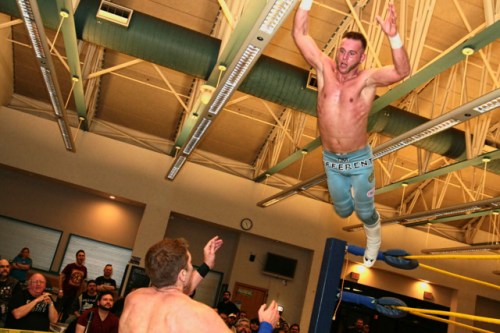
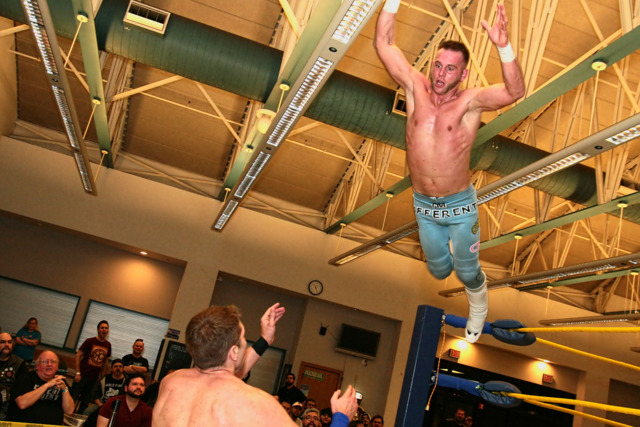
It’s Friday night in the middle of February, and the Annandale Volunteer Fire Department is electric. There’s the scent of fried food and the sound of butt rock in the air. A couple hundred people are seated around a deep blue wrestling ring, surrounded by wrestlers hawking merchandise off card tables. Promptly at 8 p.m., the rowdy crowd is treated to three hours of everything from a half-ton tag team to a pair of female Hot Topic devotees. The crowd eats it up, chanting, cheering, booing, and throwing streamers overhead. This is pro wrestling, in all its carnivalesque grandeur. This is NOVA Pro Wrestling.
Independent pro wrestling (known collectively as the “indies”) is the scrappy, low-budget cousin of World Wrestling Entertainment, the billion-dollar company that made everyone from Hulk Hogan to The Rock to John Cena into stars. Until the rise of WWE in the mid-1980s, a collection of territorial promotions that ran shows out of arenas, civic centers, and armories across the country controlled pro wrestling.
Eventually, WWE became the only game in town. The monopolization of pro wrestling led to a renaissance in the independent wrestling world, the spiritual successor to the territorial era, albeit on a smaller scale: the arenas replaced with VFW halls, the TV deals basically nonexistent. These promotions would become home to a new generation of wrestlers and wrestling fans who loved pro wrestling—not WWE’s homogenized brand of “sports entertainment.”
Two of those fans were Northern Virginia residents Mike King Jr. and his son Mike E. King. Pro wrestling was a family tradition: Big Mike had watched with his father and grandfather, going to wrestling shows at the Baltimore Arena and the Capital Centre in Landover. He started taking Little Mike to indie wrestling shows when his son was 6 years old (earlier if you count the one that he attended at the Capital Centre in utero). Because indie wrestling didn’t really exist in Northern Virginia—the closest shows were in Richmond or the Baltimore area—they would spend nearly every weekend driving up and down the East Coast and as far west as Indiana for their wrestling fix. “Some kids play soccer or baseball on a traveling team,” says Big Mike. “We liked to do wrestling.”

In early 2015, after thousands of miles on the road, the Kings “buckled down” to figure out what it would take to start a “homegrown” wrestling promotion in Northern Virginia. Big Mike wasn’t daunted by the paperwork the task entailed—he’s an office administrator by day—and they got to work, booking the first NOVA Pro show in September 2015 at the Jewish Community Center of Northern Virginia.
Little Mike had a vision for NOVA Pro Wrestling that combined all the things he loved about indie wrestling around the country. He wanted the classic pro wrestling storytelling of Southern promotions and the buzz-generating “dream matches” that fill the cards in Northeastern promotions. Every NOVA Pro event—the February show was their tenth—has built on that vision. Helping to execute that vision is Brad Stutts, a veteran of the North Carolina pro wrestling scene. “Wrestling is like a sideshow or a circus,” he explains. “If you don’t like the lion tamers, maybe you’ll like the jugglers, and if you don’t like the jugglers, maybe you’ll like the fire dancers.”
In that spirit, NOVA Pro has certainly tried to deliver something for everyone. They’ve brought in high-flyers and hosses; local upstarts and nationally-known veterans; men and women. In the first year, storylines explored a put-upon wrestler’s battle with his money-loving manager; a tag team bromance that toyed with pro wrestling’s dueling homoeroticism and homophobia; and a blood feud between two men vying to be the face of the franchise.
The latter pitted North Virginia natives Sonjay Dutt and Logan Easton LaRoux against each other. Dutt, a 17-year veteran was the hero, or “babyface,” while LaRoux was the villain, or “heel.” Each successive meeting raised the stakes, a Jenga tower of no-holds-barred and tag team matches that culminated in a steel cage match (at the JCC, optics be damned) last September. It was the highlight of NOVA Pro’s first year and the essence of the promotion: wrestlers at the top of their game, working in their backyards.
The 34-year-old Dutt—“The Original Playa from the Himalaya”—was born in D.C. and has spent almost all of his life in Northern Virginia. His parents emigrated from India in 1979, and the spectacle of pro wrestling was one of the first things his father saw on TV.
“As far back as I can remember, pro wrestling was always on in the house,” he says. “I fell in love with it right off the bat.” Turned off by the rigid structure of high school baseball, he started wrestling with his friends, gaining his first bit of notoriety at 16 when he appeared on The Best of Backyard Wrestling VHS tapes. He started training properly two years later and signed with Total Nonstop Action Wrestling (a distant second-place promotion to the WWE) at 21 years old.
Since then, Dutt has wrestled hundreds of matches around the world, including many in the indies that the Kings patronized, and their connection goes way back: One of Dutt’s first matches was at the very first indie show Little Mike attended. Dutt had been friends with the Kings for years when they reached out about starting a local promotion, and it wasn’t a hard sell. “There’s something appealing about growing something locally,” Dutt says. He offered to help however he could.
That meant anchoring NOVA Pro shows with LaRoux, a 27-year-old who calls Fairfax County home. Like Dutt, LaRoux has been wrestling since his teens, driving the miles and putting in the work (often at “real shitholes”) that it takes to break into the wrestling business. It really started to click a few years ago as he developed the Logan Easton LaRoux character, the self-described “Champion of the One Percent,” who is billed as coming from “a gated community located within a gated community that is surrounded by yet another gated community in Great Falls.”
At first, LaRoux was a little hesitant about NOVA Pro. “I didn’t know what to expect,” he admits, “because the reality of Virginia independent wrestling can be fat guys in t-shirts doing scoop slams.” Thankfully, NOVA Pro isn’t like other Virginia indies, and LaRoux embraced the opportunity to work with Dutt. “I think he’s by far the most underrated wrestler working today,” LaRoux says about Dutt, who he calls “the godfather of NOVA Pro.” Dutt is proud of the year-long feud as well, saying, “it has created a star in Logan.”
But if a star is born in Northern Virginia, is it bright enough to be seen in the pro wrestling world at-large? Years ago, the answer would probably have been no: Guys like Dutt and LaRoux—who are billed generously at 5’8” and 5’11”, respectively—were rarely regarded as WWE prospects.

That has started to change. In the 2000s, the WWE started poaching some of the indie stars that the Kings had followed around the country. Since then, the indies have been a pipeline of talent for the WWE, and in recent years, the hiring of wrestlers who didn’t fit the typical mold—men and women not traditionally tall, taut, or telegenic enough— increased to a fever pitch.
Dutt is at peace with the fact that—despite the successes of his 17-year career and the changing landscape—he had never received a tryout with the WWE. “Life is just about timing,” he says. “But anything can happen.” And he’s right: he recently spent a few weeks at the WWE’s Orlando Performance Center, helping to train recruits and produce events.
It’s unclear if that will be the extent of his work with the WWE. All he can do is keep performing. “Other than the bumps and bruises, I feel like a million bucks,” he says. His full-time schedule still includes dates with NOVA Pro, ones that present him a unique opportunity: the chance to have his children see him work. The first match his six-year-old daughter saw was a no-holds-barred match with LaRoux that included some steel chair shots. “I told her ‘daddy is out there with friends, we’re having fun, don’t worry,’ and that’s all I needed to say,” Dutt explains. “She was fine—she loved it.”
The then-five-year-old was a natural, getting in LaRoux’s face and cheering for her father. She was also at the match in February … as was Dutt’s 12-week-old son. “My daughter really wanted to come and my son is too young to be with a sitter yet, so my mom brought him,” Dutt says. “He did amazing. I’m surprised that nothing really freaked him out!”
Time will tell if his son enjoys watching wrestling as much as his sister, but Dutt has an idea how that might turn out: when the time is right, “he might want to get in and fight, too.”
Originally published in the Washington City Paper.







 Postcultural